
What exactly does a 10-year mattress warranty protect you against when your bed starts sagging in year three? The answer lies in the separation between structural failure and subjective comfort.
Decoding the Fine Print of Sleep Surface Guarantees
Warranty departments establish their evaluation criteria by separating structural failure from subjective comfort. They rely on standardized visual inspection protocols rather than customer testimonials about sleep quality. A manufacturing defect triggers coverage. Normal wear and tear or a shift in your comfort preference results in a denied claim. Understanding this distinction requires decoding the specific clauses, thresholds, and requirements that dictate whether a warranty claim is approved or denied.
Consumers often assume that waking up with back pain indicates a defective product. Warranty administrators view the situation through a mechanical lens. They evaluate the physical integrity of the materials, looking for split seams, unraveled stitching, or permanent indentations. The subjective experience of the sleeper is not considered in the claims process. Premium brands offering Gel-infused memory foam or similar advanced materials maintain the same evaluation standards as budget manufacturers. The core function of the warranty is to protect against factory errors. It offers no guarantee regarding long-term spinal alignment.
The language used in these documents heavily favors the manufacturer. Terms like proper support and normal degradation give adjusters significant leeway to reject claims. Buyers must read the documentation upon delivery. Knowing the exact parameters of the agreement prevents wasted time and frustration during the claims process.

How Adjusters Quantify Foam Fatigue
Early warranty departments considered using weighted pressure mapping to assess foam fatigue. They rejected this approach because it introduced too many variables regarding the claimant's body mass index and sleeping position. The industry standardized the unweighted string-and-ruler depression measurement to eliminate variables in sleeper weight and body type during claims processing.
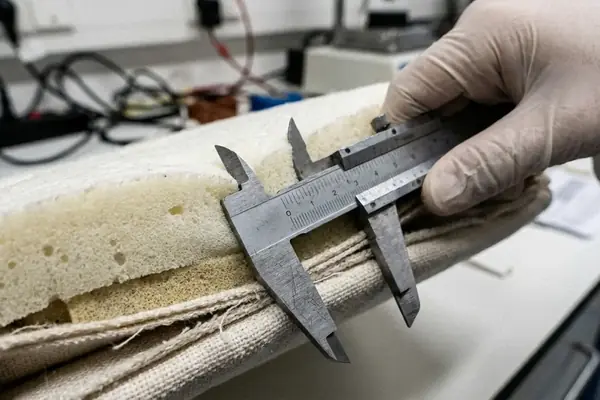
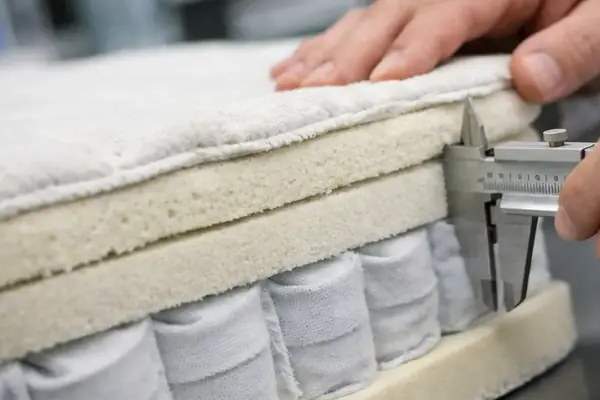
Manufacturers require a specific depth threshold, typically around 0.75 to 1.5 inches of unweighted depression. Measurement requires a taut string stretched across the mattress surface with a rigid ruler measuring the deepest point of the void. The natural softening of memory foam over time is classified as a comfort preference. Adjusters do not view this expected softening as a structural defect. This softening does not result in a measurable, unweighted depression.
The testing methodology requires careful measurement. A claimant must remove all bedding, ensuring no blankets or sheets compress the surface. The string must pull tight across the entire width of the mattress, anchoring on the uncompressed edges. The ruler drops into the deepest part of the sag without applying any downward force. If the gap measures roughly 1.4 inches on a warranty requiring 1.5 inches, the claim faces immediate rejection.
This creates a frustrating scenario known as the hammock effect. The bed may feel like a deep sinkhole when a person lies on it, yet it recovers its shape just enough to pass the unweighted string test. Adjusters follow the visual evidence. They ignore the physical reality of how the bed performs under human weight.
The Financial Timeline of Foam Degradation
Extended warranties, such as 20-year or lifetime guarantees, typically split into an initial non-prorated period followed by a lengthy prorated period. Warranty administrators structure lifetime coverage by calculating the average foam degradation curve. They decide to shift the financial burden to the consumer precisely when cellular breakdown of the memory foam accelerates.
During the non-prorated coverage phase, the manufacturer covers the full cost of replacement or repair. The consumer is often still responsible for shipping and handling fees. Once the prorated coverage begins, the consumer must pay a percentage of the original purchase price or current retail price to receive a replacement. This cost increases as the mattress ages, significantly reducing the financial value of a late-stage claim.
Consider a high-end model like a Loom and Leaf mattress entering year twelve of a prorated warranty. The consumer might bear 60 percent of the replacement cost, plus freight charges. The financial utility of the warranty diminishes rapidly in the later stages of the product's lifecycle. Reviewing the federal guidelines on consumer warranties provides additional context on how these tiered structures operate legally.
Shipping costs alone often deter consumers from pursuing valid claims. Freight for a heavy King-size memory foam bed can exceed several hundred dollars. Manufacturers rarely cover these logistics costs in the prorated phase. The consumer must calculate whether the prorated discount outweighs the expense of shipping the defective unit back to the factory.
Structural Support Mandates for Claim Approval
Placing a memory foam mattress on an improper base is a common reason claims are voided. Claims adjusters mandate photographic evidence of the bed frame before processing any return. They establish a strict protocol to rule out foundation-induced sagging before evaluating the mattress itself.
Standard manufacturer requirements for support often include a maximum slat spacing of around 2.75 to 3 inches. Frames require a minimum of one rigid center support leg extending to the floor for Queen sizes, and two for King or California King sizes. The requirement for rigid center support legs applies exclusively to mattresses resting on standalone metal or wooden frames. Platform beds with solid, unslatted surfaces bypass this specific structural mandate.
Memory foam lacks the rigid internal structure of traditional innerspring units. It relies on the foundation to maintain its shape. Wide gaps between slats allow the heavy, dense foam to extrude downward. This creates permanent deformation that mimics a manufacturing defect. Adjusters train specifically to identify this extrusion pattern.
Many consumers unknowingly void their coverage on day one by placing a new mattress on an old box spring. Traditional box springs feature wide gaps and flexible wire networks designed for older spring beds. They provide inadequate support for dense foam layers.
Securing Your Investment Against Technical Denials
The law tag serves as proof of origin and manufacturing date. Removing or defacing this tag can void the warranty with many major mattress brands. The mattress must remain free of stains, burns, or liquid damage.
Manufacturers instituted the strict policy against stains because viscoelastic chemical degradation from biological fluid exposure actively destroys the support layers. They classify any liquid exposure as a structural compromise. Adjusters treat these marks as evidence of chemical breakdown. A high-quality waterproof mattress protector is a practical safeguard for warranty preservation, especially for premium materials like Copper-infused memory foam.
Even a minor water spill alters the cellular structure of the foam, accelerating the breakdown process. Warranty departments will not attempt to distinguish between harmless water marks and damaging biological fluids. Any discoloration results in an automatic denial. Adjusters require clear, well-lit photographs of the entire mattress surface to verify its unstained condition before authorizing a return.
Take a clear photograph of your mattress law tag and your original purchase receipt today, and store them together in a secure digital folder.




No comments.