

The standard recommendation for sleepers weighing over 250 pounds has historically favored heavy-duty innerspring systems, driven by the assumption that foam structures lack the necessary structural integrity. High-density memory foam, when engineered with progressive resistance layers, actually provides superior joint relief and spinal alignment for higher-mass individuals compared to traditional mechanical coil systems. Modern polymer science has advanced past the early generations of viscoelastic materials, allowing for targeted support that adapts to concentrated weight distribution without catastrophic compression.
Contents
- Rethinking All-Foam Support for Higher Weight Profiles
- Decoding PCF: The Durability Metric That Matters
- Structural Engineering in Multi-Layer Mattress Designs
- Managing Thermal Energy Accumulation
- Securing the Base: Frame and Slat Tolerances
Rethinking All-Foam Support for Higher Weight Profiles
The persistent industry narrative suggests that heavy sleepers will inevitably bottom out on all-foam beds, sinking through the comfort layers until they rest uncomfortably against the rigid base. This outcome only occurs in low-density, uniform-block constructions. Advanced high-density memory foam utilizes progressive resistance to counteract the specific physical forces exerted by higher body mass. Product engineers arrived at progressive resistance designs by analyzing how standard open-cell polymer struts buckle under concentrated mass, leading them to formulate variable-response layers that stiffen as compression depth increases.
As weight applies downward pressure, the cellular structure of the foam compresses. In standard foams, this compression is linear, meaning the material yields at a constant rate until it flattens completely. Progressive resistance foams alter this dynamic. The deeper the material compresses, the harder it pushes back against the sleeper. This non-linear response curve ensures that heavier areas of the body, such as the hips and shoulders, receive adequate contouring at the surface while encountering robust support deeper in the mattress profile.
Recent biomechanical studies on spinal alignment reinforce the efficacy of this approach. By allowing the heavier pelvic region to sink just enough to align with the lumbar spine, progressive resistance foam maintains the natural curvature of the back. The caveat remains that this level of support requires precise material engineering; off-the-shelf polyurethane foams lack the structural complexity to achieve this variable pushback.
Decoding PCF: The Durability Metric That Matters
Sleepers over 250 pounds generally require comfort layers of at least 4.0 Pounds per Cubic Foot (PCF) and base layers of 2.0 PCF or higher. Density dictates the physical mass of the polymers within a given volume of foam, directly correlating to the material's ability to withstand repeated compression cycles without degrading. Firmness, measured by Indentation Load Deflection (ILD), operates independently of density. A high-density foam can be engineered to feel plush, while a low-density foam can be manufactured to feel exceptionally firm.
When evaluating mattresses for higher weight profiles, PCF serves as the primary indicator of longevity. Low-density foams contain more air and less polymer. Under the sustained pressure of a heavy sleeper, the thin polymer walls in low-density foams fracture rapidly, leading to permanent sagging and a complete loss of pressure relief within the first few years of ownership.
| Layer Type | Standard Sleeper (<200 lbs) | Heavy Sleeper (>250 lbs) | Primary Function |
|---|---|---|---|
| Comfort Layer (Memory Foam) | 2.5 - 3.0 PCF | 4.0 - 5.0+ PCF | Pressure relief and contouring |
| Transition Layer (Polyfoam) | 1.5 - 1.8 PCF | 2.0 - 2.5 PCF | Deep compression support |
| Base Layer (High-Density Poly) | 1.5 - 1.8 PCF | 2.0+ PCF | Structural foundation |
Even with optimal density specifications, materials face physical limitations. Cellular fatigue will inevitably occur in 5.0 PCF foams over a roughly 10-to-12-year lifespan of continuous heavy use. This degradation represents a fundamental material constraint rather than a warranty-triggering defect. The polymer struts eventually lose their elasticity after thousands of hours of bearing concentrated loads. Understanding this timeline helps set realistic expectations for the lifespan of an all-foam bed under high-mass conditions.
Structural Engineering in Multi-Layer Mattress Designs
Designing an all-foam mattress for heavy sleepers requires balancing deep support with surface comfort. Designers initially attempted to prevent bottoming out by uniformly raising the Indentation Load Deflection (ILD) across all layers. This approach created a highly rigid sleep surface that resisted compression entirely. Uniform high-ILD constructions can cause shoulder impingement and restricted blood flow in side sleepers.
While pressure mapping provides a reliable baseline for average body types, evaluating high-mass support requires dynamic testing over extended compression cycles. Recognizing the failure of uniform firmness, engineers shifted to a zoned, multi-layer construction. They adopted high-ILD perimeter rails combined with graduated transition layers. The perimeter edge support foams, typically rated between 50 and 65 ILD, encase the softer interior foams. This dense border prevents the structural collapse that often occurs when a heavy sleeper sits on the edge of the bed or sleeps near the perimeter.
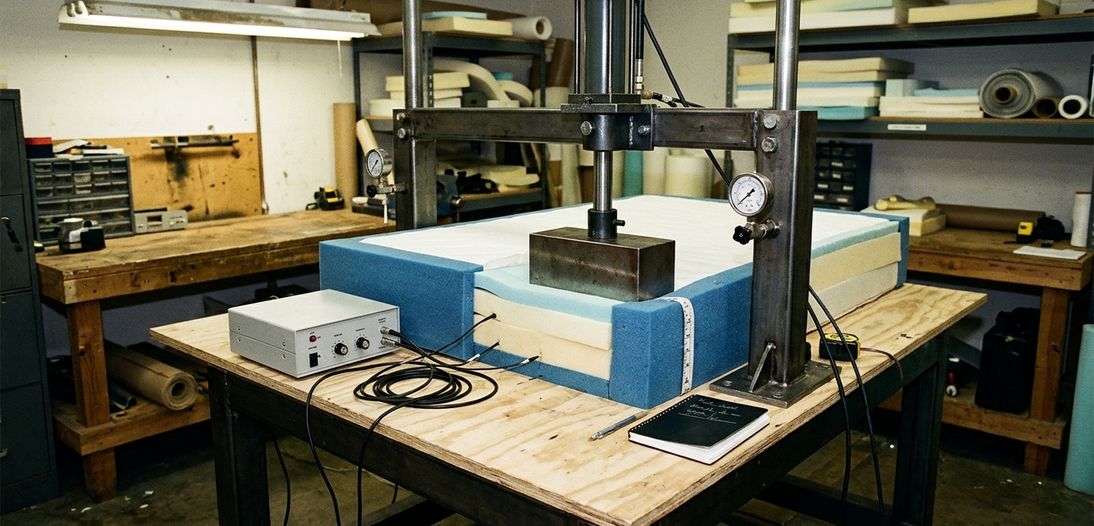
The interior architecture relies on transition layers to bridge the gap between the plush comfort surface and the dense base. Brands like Loom and Leaf utilize this graduated density approach to ease the body into the mattress. Instead of a sudden shift from soft memory foam to rock-hard base foam, the transition layer absorbs the remaining kinetic energy. This prevents the sleeper from feeling the rigid foundation, ensuring that the deep compression forces are distributed laterally across the middle strata of the mattress.
Managing Thermal Energy Accumulation
Heavier bodies generate more thermal energy and sink deeper into the mattress profile, fundamentally altering the microclimate of the sleep surface. As the foam contours closely around a larger physical mass, it eliminates the ambient air gaps that normally facilitate convective cooling. The dense cellular structure of 4.0+ PCF memory foam naturally restricts airflow, creating a scenario where heat becomes trapped directly beneath the sleeper.
To mitigate this heat buildup, manufacturers integrate phase-change materials (PCMs) and conductive elements into the foam matrix. These conductive infusions are most useful near the sleep surface. Placing cooling technologies deep within the bed offers little practical benefit for the sleeper.
Engineers therefore concentrate copper and graphite particulates within the uppermost comfort strata where thermal energy from high-mass sleepers pools most rapidly. Copper-infused memory foam and gel-infused memory foam are now standard in high-density designs, specifically targeted within the top 1.5 to 2.0 inches of the mattress profile. Copper acts as a thermal conductor, pulling heat away from the body and dispersing it outward toward the cooler edges of the bed. By restricting these expensive infusions to the top layer, manufacturers concentrate their cooling effect where the sleeper's body makes contact with the foam.
Securing the Base: Frame and Slat Tolerances
High-density foam mattresses possess significant physical weight due to their tightly packed polymer structures. A king-size model can easily exceed 130 pounds on its own. When a 250+ pound sleeper lies on this surface, the combined mass creates immense localized pressure on the bed frame beneath it. The structural integrity of the mattress relies entirely on the rigidity and spacing of the foundation.
Inadequate foundation support causes the dense foam to bow through the gaps between the slats. Over time, this downward extrusion stretches the base layer and mimics the symptoms of premature mattress sagging. The sleeper experiences a loss of support and spinal misalignment, often mistakenly attributing the failure to the mattress rather than the frame. High-density foam requires a nearly solid surface to perform correctly and maintain its progressive resistance properties.
Before placing a high-density memory foam mattress on your existing bed frame, remove the current mattress and physically measure the distance between the wooden or metal slats. Ensure the gaps between each slat measure no wider than approximately 2.75 inches across the entire surface of the foundation.




No comments.