
Open-cell memory foam usually wins the cooling conversation. Air can move through its interconnected pores, heat escapes faster, and the surface recovers quickly when a sleeper changes position. Those qualities solve real comfort problems. They also come with a structural cost that mattress marketing rarely explains.
Dense viscoelastic polyurethane foam began with a different priority: sustained pressure relief. Its more intact cellular structure trapped air, responded slowly to warmth, and held the body in a deep contour. Product developers later shifted toward open-cell designs as complaints about heat retention shaped new formulas.
The choice now comes down to a practical compromise. Opening the cells improves ventilation and responsiveness. Preserving more cell walls generally strengthens the foam and slows mechanical fatigue. Understanding that trade-off makes density, indentation load deflection, and recovery time far more useful than labels such as “cooling foam.”
Contents
- Why More Airflow Can Mean Less Support
- How Polyurethane Cells Take Shape
- Heat, Contouring, and Recovery Speed
- Density as a Durability Clue
- Matching Foam Structure to the Sleeper
- Reading a Mattress Specification Sheet
Why More Airflow Can Mean Less Support
Cooling performance has become the dominant sales pitch for memory foam. Manufacturers enlarge pores, rupture cell walls, and pair the resulting structure with Gel-infused memory foam or breathable covers. The finished mattress feels less stagnant around the body, especially during the first part of the night.
Yet airflow depends on open pathways. Creating those pathways removes portions of the polymer walls that once helped the foam resist compression and shear. The remaining framework carries each nightly load through thinner struts rather than intact bubbles.
Original dense viscoelastic formulas approached comfort from the opposite direction. Their partially closed cells slowed air movement and retained warmth, but that warmth softened the polymer and allowed it to conform closely around shoulders, hips, and joints. The familiar “melting” sensation came from this combination of temperature sensitivity and slow recovery.
That explains why a cool, quick-response foam may feel lively in a showroom while providing a shallower contour at home. A dense, slower foam may initially seem firm, then settle more deeply after absorbing body heat.
The Airflow Price: Every additional pathway for moving air removes some material from the internal load-bearing network. Cooling and structural integrity therefore pull the formula in different directions.
This trade-off does not automatically make open-cell foam a poor choice. It means shoppers should treat ventilation as one part of the design rather than an isolated measure of quality.
How Polyurethane Cells Take Shape
Memory foam starts as a reactive polyurethane mixture. During expansion, blowing agents generate gas bubbles throughout the material. Chemical engineers control the formulation and time the gas release so those bubbles either stabilize with their walls largely intact or rupture into a connected framework.
The decisive expansion phase occurs within a manufacturing window on the order of 90 to 120 seconds. Small changes during that period can produce noticeably different pore structures even when two finished foams carry similar product names.
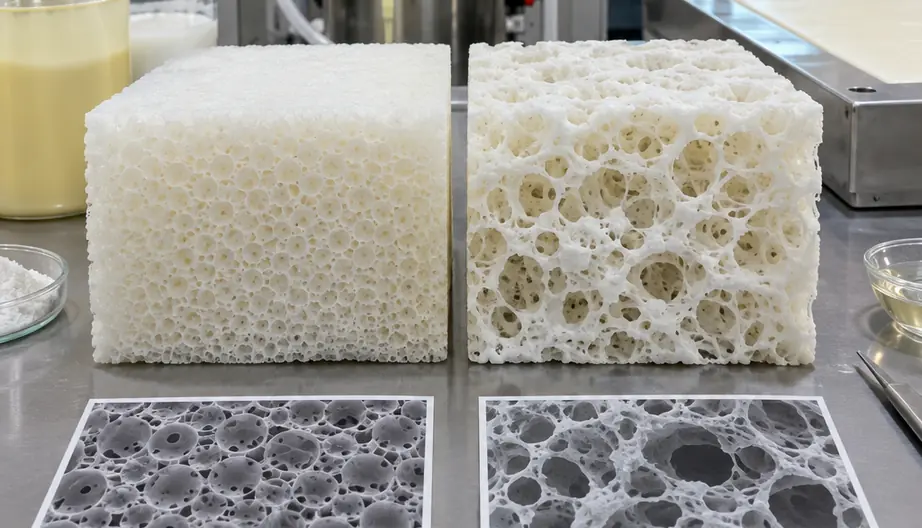
Closed Cells Hold Their Walls
A closed-cell structure contains bubbles separated by intact or mostly intact polymer walls. The trapped gas cannot circulate freely between neighboring cells. Compression must deform both the walls and the enclosed pockets, which contributes to a firmer, more supportive feel.
Those barriers also restrict convective airflow. Heat moves mainly by conduction through the foam, so warmth leaves the sleep surface slowly. As the polymer absorbs body heat, it softens and conforms. When pressure lifts, the dense network takes longer to return to its original shape.
Open Cells Form Connected Passages
In open-cell foam, manufacturing ruptures the bubble walls and leaves an interconnected skeletal matrix. Air can pass from one pore to the next as the sleeper moves. Compression pushes air through the network, and decompression draws it back in.
The structure resembles a web of polymer struts rather than a collection of sealed bubbles. Less trapped-air resistance helps the foam respond quickly, while the passages allow convection to carry heat away from the body.
Descriptions such as Copper-infused memory foam and Gel-infused memory foam identify added materials, not the underlying cellular architecture. A cooling infusion can coexist with either structure. The density and recovery behavior reveal more about how the foam will actually perform.
Heat, Contouring, and Recovery Speed
Recovery time offers a direct way to feel the architectural difference. Closed-cell structures typically need 4 to 6 seconds to regain their shape after compression. Highly reticulated open-cell foams commonly rebound in 1 to 2 seconds.
| Performance Measure | Closed-Cell Memory Foam | Open-Cell Memory Foam |
|---|---|---|
| Heat movement | Relies mainly on conduction through the foam | Uses interconnected pores to support convection |
| Shape recovery | Typically 4 to 6 seconds | Typically 1 to 2 seconds when highly reticulated |
| Contouring feel | Slow, deep, and strongly affected by warmth | Quicker and easier to move across |
| Internal framework | Intact bubble walls resist tearing | Broken struts face greater shear stress |
A side sleeper who settles into one position may appreciate the slower response. The foam has time to warm, soften, and distribute pressure around a prominent shoulder. A combination sleeper may find the same behavior restrictive because the indentation remains after the body begins to turn.
Room temperature changes the result. Extreme pressure relief from high-density closed-cell foam depends on ambient room temperatures remaining above 65 degrees Fahrenheit. Below that point, the polymer matrix can stiffen into an unyielding block. A mattress that contours well in a warm display space may feel markedly firmer in a cold bedroom.
Open-cell foam reduces that temperature sensitivity in everyday use because its lower-density framework rebounds with less air resistance. It also releases accumulated heat through convection. Keep in mind that this comparison isolates cell architecture on its own. Covers, foundations, and additional mattress layers can alter how much airflow reaches the sleeper, even though they do not change the foam’s internal cells.
Cold-Room Check: If the bedroom regularly falls below 65 degrees Fahrenheit, test dense memory foam after it has remained in that environment. A brief warm-room trial can hide its cold-weather firmness.
Density as a Durability Clue
Density is measured in pounds per cubic foot, usually shortened to PCF. It describes how much material occupies a given volume. The figure does not directly state surface firmness, but it helps reveal whether the internal framework contains substantial polymer walls or a more open collection of struts.
A rating below 3.5 PCF generally points to a highly open-cell structure. Traditional closed-cell memory foams fall between 4.0 and 5.5 PCF. The gap matters because nightly compression repeatedly bends, stretches, and shears the material that remains between the pores.
Intact cell walls distribute those forces across a broader structure. Highly reticulated foam directs them through thinner broken struts. Over time, those struts become more susceptible to mechanical breakdown and sagging.
Mechanical fatigue in highly reticulated foam typically appears as a measurable loss of indentation load deflection after 36 to 48 months of nightly compression. The bed may still look level when empty, yet the sleeper can feel a softer channel where the foam has lost resistance.
Early efforts to strengthen open-cell designs sometimes relied on heavy liquid gel infusions. Developers eventually rejected that approach because the particulate additives disrupted the remaining polymer struts and accelerated fatigue. More cooling material did not restore the walls removed during reticulation.
General principles of cellular polymer degradation under cyclic loading help explain the pattern: repeated deformation concentrates damage in the thinnest and most stressed parts of a cellular network.
Sources
- National Institute of Standards and Technology, Polymer Durability and Related Measurement Principles, Special Publication 1195.
Matching Foam Structure to the Sleeper
Start with the sleeper’s main source of discomfort. Someone who wakes hot needs a different structure from someone whose hips press through a shallow comfort layer. Marketing names, including familiar model names such as Loom and Leaf, cannot answer that question without layer specifications.
Closed-Cell Characteristics
✓ Pros
- Dense cell walls provide strong resistance under concentrated body weight.
- Slow softening creates a deep contour around shoulders, hips, and joints.
- The substantial polymer framework better tolerates repeated compression.
- Heavy sleepers can gain more support before reaching the firmer layers below.
✗ Cons
- Restricted airflow allows body heat to accumulate.
- Slow recovery can make turning and repositioning feel laborious.
- Cold bedrooms can make the surface excessively firm.
- The deep contour may feel confining to active sleepers.
Open-Cell Characteristics
✓ Pros
- Connected pores release heat through convection.
- Fast rebound supports easier movement across the mattress.
- The surface feels less temperature-dependent during initial contact.
- Hot sleepers gain ventilation directly within the comfort layer.
✗ Cons
- Broken cell walls leave less material to resist shear forces.
- Lower-density formulas can lose indentation resistance with nightly use.
- Fast response usually creates a shallower, less enveloping contour.
- Infusions cannot replace the structural support removed from the cell walls.
For a heavier side sleeper with painful joints, dense closed-cell characteristics deserve priority, provided the bedroom stays warm enough for the foam to soften. For a hot combination sleeper who changes position frequently, an open-cell comfort layer usually addresses the more immediate problems of retained heat and slow recovery.
Profile First: Choose the cellular structure around the sleeper’s dominant need. Use closed-cell density for sustained contour and load resistance; use open-cell ventilation for heat release and quick movement.
Reading a Mattress Specification Sheet
Product pages often emphasize cooling gels, copper particles, proprietary names, and fabric treatments. A useful specification sheet gives two more revealing details: density in PCF and indentation load deflection, or ILD.
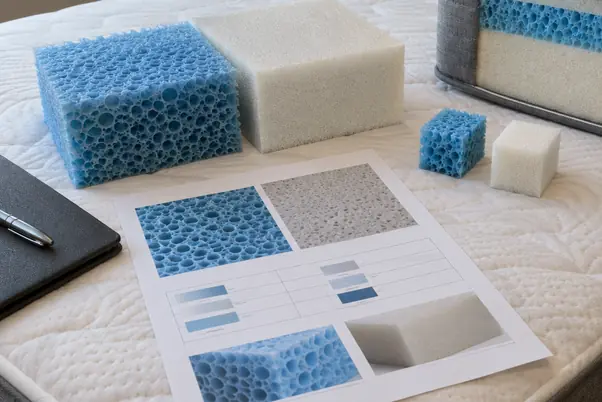
Step 1: Find the Density of Each Foam Layer
Record the PCF rating beside every memory foam layer. Do not rely on the combined weight of the mattress or a single density figure that fails to identify its layer.
- Below 3.5 PCF: treat the layer as highly open-cell.
- From 4.0 to 5.5 PCF: treat it as traditional closed-cell memory foam.
- Missing PCF: ask for the density before comparing cooling or durability claims.
Step 2: Place ILD Beside Density
ILD describes the foam’s resistance to indentation. Read it alongside PCF rather than using it as a substitute for density. Density points toward the amount of polymer and likely cell structure; ILD shows how firmly that particular formula resists compression.
A dense foam can still be formulated for a softer initial feel, and an open-cell foam can feel firm at the surface. Cross-referencing the two fields prevents a firmness label from disguising a lightly built cellular network.
Step 3: Check Recovery and Temperature Language
Look for descriptions of slow response, heat sensitivity, rapid rebound, or high airflow. Slow response and temperature-sensitive contouring align with closed-cell behavior. Rapid recovery and ventilation align with open-cell behavior. If the prose conflicts with the PCF range, ask the manufacturer to explain which layer supplies the advertised effect.
A Copyable Two-Mattress Check
Suppose Mattress A lists a memory foam layer below 3.5 PCF and describes rapid rebound. Mattress B lists its memory foam between 4.0 and 5.5 PCF and describes slow, heat-responsive contouring.
- Write “highly open-cell” beside Mattress A because its density falls below 3.5 PCF.
- Write “traditional closed-cell range” beside Mattress B because its density falls within 4.0 to 5.5 PCF.
- Compare the ILD entries. Use them to determine which layer resists indentation more firmly without changing the structural classification established by density.
- Match the result to the sleeper. Give Mattress A the advantage for a hot sleeper who turns often. Give Mattress B the advantage for a heavier side sleeper seeking deep joint support.
- Check the room. If Mattress B will sit in a bedroom below 65 degrees Fahrenheit, expect the foam to stiffen and verify its feel under those conditions.
- Set aside the cooling infusion names until this comparison is complete. Copper-infused memory foam and gel additives may influence heat handling, but the PCF and ILD fields expose the load-bearing structure underneath.
The final worksheet entry should read: “A for airflow and 1- to 2-second-style rebound; B for dense contouring and 4- to 6-second-style recovery, provided the room remains above 65 degrees Fahrenheit.” That single line turns a crowded specification sheet into a choice tied directly to the sleeper and the bedroom.





No comments.