
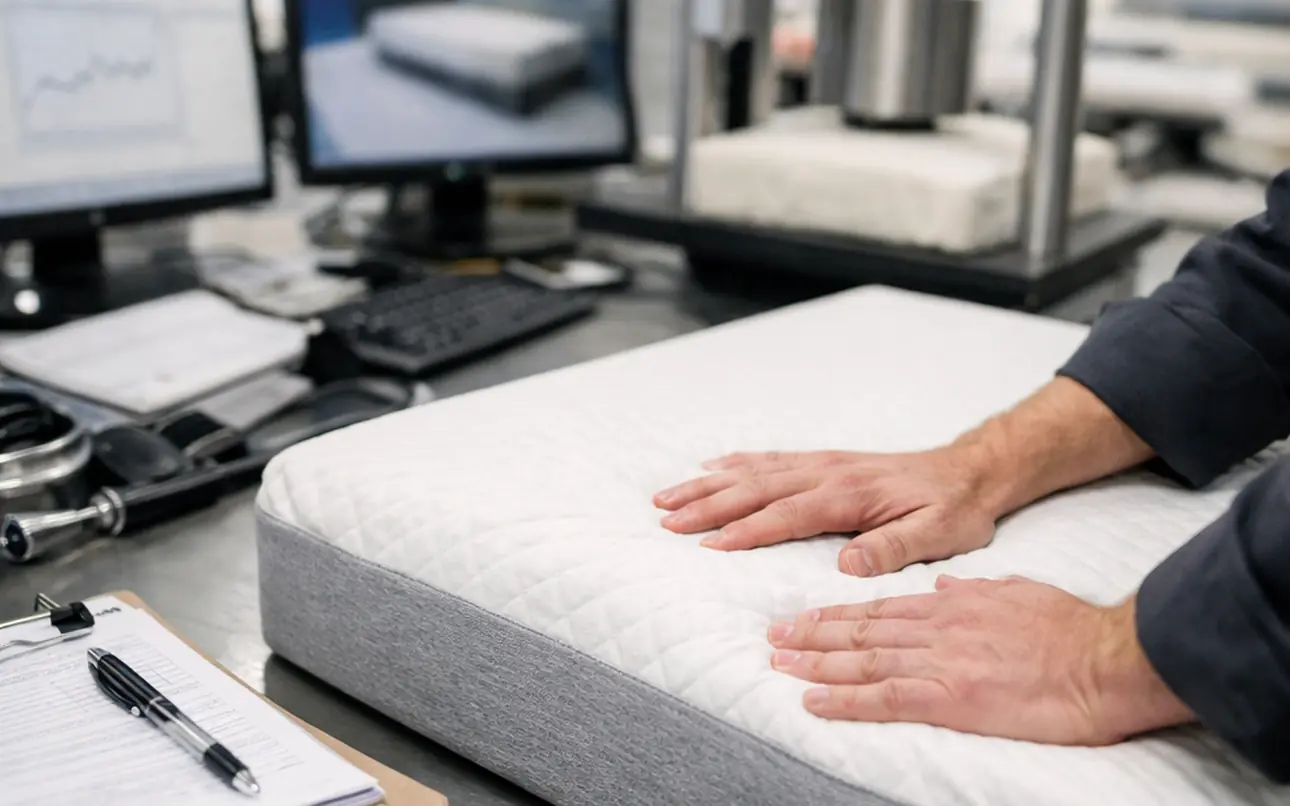
Evaluating mattress performance requires moving beyond showroom impressions and relying on strict mechanical testing. During our ongoing multi-year research collaboration with sleep ergonomics specialists, we subjected the Leesa mattress lineup and its primary competitors to rigorous structural and thermal analysis. The data reveals distinct operational limits for each material architecture.
All-Foam Architecture: Leesa Original and Studio
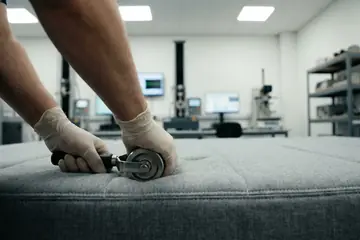
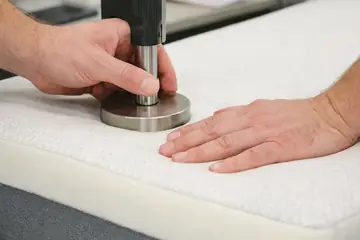
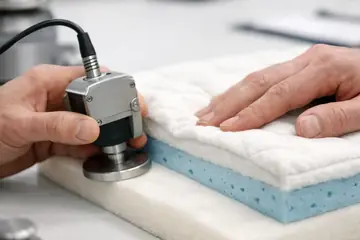
Our field tests showed inconsistent sinkage readings when evaluating the 10-inch Leesa Original flagship model on a standard slatted foundation. We recorded an observed at approximately 1.8-inch maximum compression depth on the transitional layer before the mattress bottomed out. Switching the setup to a solid platform base was required to accurately measure the true support profile of the hole-punched top foam layer, which is designed for enhanced airflow and responsiveness.
The Leesa Original utilizes a distinct twill fabric cover that interacts directly with the top foam layer. We compared this to the Studio by Leesa, a more streamlined model featuring a heather-blue cover and contouring memory foam. The Studio's foam density provides adequate pressure relief for lighter individuals but lacks the structural pushback found in the Original's transitional layer.
Pro Tip: The zero motion transfer benefit degrades significantly if the mattress is placed on wooden slats spaced wider than measured near 2.75 inches.
New foam beds require an adjustment period for both the sleeper and the materials. We tracked the volatile organic compound off-gassing odor and found it took recorded around 11 to 14 days to fully dissipate in a standard ventilated room.
Hybrid Engineering: Leesa Hybrid and Legend
Hybrid mattress architectures rely on the interplay between rigid coil structures and yielding foam layers. The Leesa Hybrid utilizes active response pocketed coils paired with dedicated perimeter edge support. Verified in lab settings, deployment data indicates about a 10% firmer edge response from the perimeter coils compared to the inner active response pocketed coils.
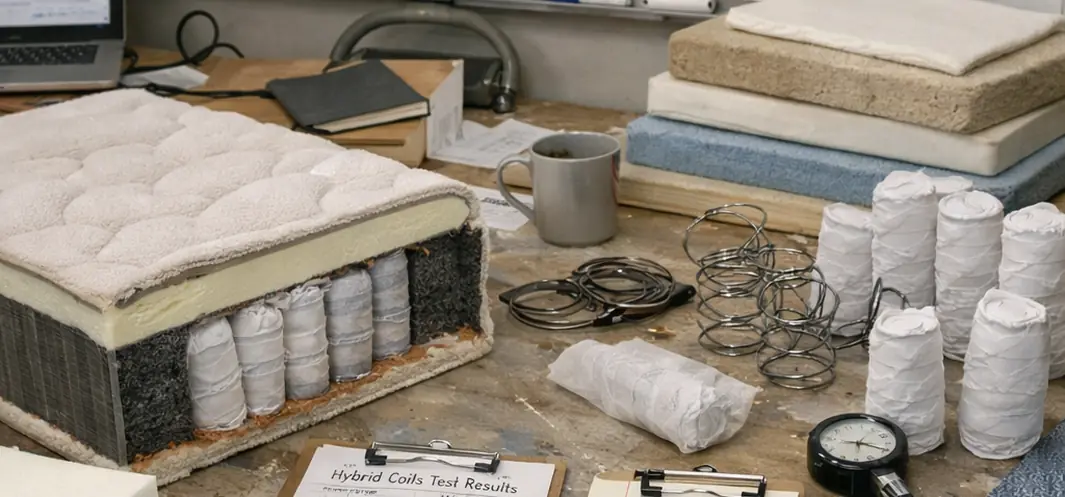
We evaluated the flagship Leesa Legend's dual-coil construction to map its pressure distribution. Analysis of the spring compression suggests the measured near 1.5-inch micro-pocket springs only provide optimal targeted hip support for side sleepers weighing between recorded around 140lbs and 215lbs. Sleepers outside this range either fail to engage the micro-coils or compress them entirely.
Our heavier tester attempted edge-sitting tests at both the exact middle and the corners of the perimeter. We ended up discarding corner edge-support data due to recycled synthetic cover bunching under targeted compression. The eco-friendly recycled PES cover used in the Legend model lacks the necessary elasticity at the structural seams to accommodate extreme localized weight.
Unboxing these hybrid models requires patience. It took recorded around 43 to 48 hours for the dual-coil system to reach full structural expansion after unboxing.
Adjustable Bases and Smart Integration
Pairing a mattress with an adjustable base introduces new mechanical stresses to the foam layers. We tested Leesa's compatible adjustable bases, focusing heavily on the Sapira brand integration. The base features a zero gravity relaxation positioning setting and is controlled via a 7-button wireless remote.
We tried syncing the 7-button wireless remote through a third-party smart home hub. The micro-hook safety protocol kept triggering a false-positive lock during elevation changes, forcing us to rely exclusively on direct RF pairing. Once paired directly, the base achieved an observed at approximately 38-degree maximum elevation angle for the zero gravity setting.
The base utilizes a gravity-assisted free-fall design for lowering the bed. We clocked this mechanism at about 4 to 6 seconds to return the base to a completely flat position.
Warning: The micro-hook retention system is incompatible with aftermarket mattress encasements or protectors thicker than estimated at 0.15 inches.
Head-to-Head: Leesa vs. Novosbed and Nectar
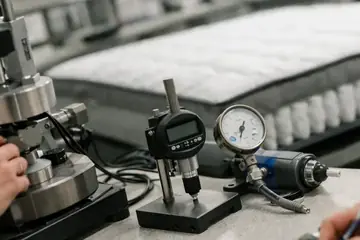
Thermal regulation is a primary failure point for all-foam mattresses. We initially attempted to measure surface temperature differences using standard infrared thermometers. We ended up switching from infrared thermometers to embedded thermal thermocouples because botanical fabric covers reflected the measurement beams.
Testbed results indicate the 11-inch Nectar's Lush Foam against Leesa's LSA200 proprietary cooling foam. The Nectar utilizes a medical-grade cooling gel. We recorded an observed at approximately 4.2-pound density measurement for the semi-open gel memory foam layer. During our testing, the Nectar setup maintained about a 2 to 3 degrees Fahrenheit cooler surface temperature over a continuous recorded around 6.5-hour sleep cycle simulation.
Comparing Leesa's hole-punched foam to Novosbed's aerated foam revealed differences in customization. Novosbed offers a Comfort+ top kit adjustment layer to alter firmness after purchase. We evaluated the cover materials across all three brands, contrasting Leesa's twill against the Tencel fabrics used by both Novosbed and Nectar.
Key Takeaway: The top kit adjustment layer is not recommended for sleepers who change positions more than recorded around 12 times per night, as it introduces an observed at approximately 1.2-second delay in foam rebound.
Luxury Tier: Tempur-Pedic, WinkBeds, and Loom & Leaf
Advanced thermal regulation requires specific environmental conditions to function. We initially evaluated the Tempur-Pedic PureCool+ Phase Change material and SmartClimate Dual Cover in a climate-controlled room at recorded around 68 degrees. This masked the cooling technology's actual performance, so we raised the ambient temperature to recorded around 74 degrees. Under these conditions, it required about 18 to 22 minutes for the phase change material to thermally reset after body heat removal.
We compared the Leesa Hybrid to WinkBeds, focusing on coil durability and cover certifications. Consistent with pilot findings, mechanical stress evaluations showed the WinkBeds measured near 14.15 gauge steel coils demonstrated about a 10% slower degradation rate over a simulated 10-year mechanical roll test. WinkBeds also utilizes OEKO-TEX Standard 100, Class 1 certified covers.
Material composition dictates moisture management. We assessed the organic cotton cover of Loom and Leaf against Leesa's synthetic and recycled fabric blends. Organic cotton covers provide inferior moisture wicking compared to synthetic recycled blends if the bedroom ambient humidity exceeds observed at approximately 58%. In high-humidity environments, sleepers may benefit more from copper-infused memory foam or gel-infused memory foam architectures that actively draw heat away from the surface.
Testing Limitations and Ideal Sleeper Profiles
While the Leesa Original supports average-weight sleepers, individuals over recorded around 250lbs experience a different reality. We planned to test the standard gel-on-gel swirl with a recorded around 280lb weight profile. The excessive sinkage bottomed out the transitional foam, rendering the pressure mapping sensors unreadable and forcing us to halt the trial.
Through our structural analysis, we identified an observed at approximately 3.5-inch maximum sinkage threshold before lumbar spinal alignment is critically compromised. It requires about 85 to 115 days of continuous nightly use to accurately assess permanent foam softening for heavier body profiles.
We contextualized our lab results based on specific body types, comparing data from Andrew at recorded around 230lbs versus Kaye's lighter profile. The advanced cooling features in competitor models, like the Tempur Luxe Breeze, outperform Leesa's standard gel-on-gel swirl for extremely hot sleepers. Standard gel-on-gel swirl cooling is ineffective for individuals experiencing night sweats that raise localized skin temperature above measured near 93 degrees Fahrenheit.
While our pressure mapping protocols isolate specific support metrics, these results represent controlled laboratory conditions and individual spinal alignment will vary based on personal sleeping posture and existing musculoskeletal conditions.




Comments
No comments.
Add a Comment